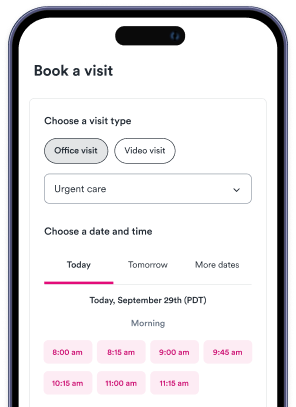
Urgent care near me
On-demand lab testing
Ensure your health. Get tested today.
Convenient lab testing at your fingertips at more than 5,000 locations nationally. Consult with a doctor, or get tested on your own.

If you have had a urinary tract infection before, you know the symptoms well: a burning feeling when you urinate, frequent urgent trips to the bathroom, and sometimes pelvic pressure or cloudy urine. With at-home UTI test strips now widely available at pharmacies, many people wonder whether they can skip the clinic visit and just test themselves. The short answer: at-home tests can be a useful first step, but they have meaningful limitations — and some UTI situations always require professional evaluation.
At-home UTI tests are small plastic strips with chemical pads that react when dipped into a urine sample. Most test for two markers: leukocyte esterase and nitrites. Leukocyte esterase is an enzyme released by white blood cells, which flood the urinary tract during infection. Nitrites are produced when certain bacteria — most commonly Escherichia coli — convert urinary nitrates through their metabolism.
A positive result for both markers is a reasonably strong indicator of a bacterial UTI. However, not all bacteria that cause UTIs produce nitrites, and leukocyte esterase can be elevated for reasons other than infection, such as inflammation or contamination of the sample. The test cannot tell you which bacteria are present, whether those bacteria are resistant to common antibiotics, or how severe the infection is.
Studies have found that at-home dipstick tests have a sensitivity of roughly 70 to 80% for detecting UTIs — meaning they miss about 20 to 30% of true infections. If your symptoms are strong and your test is negative, you should still see a provider.
When you visit a clinic for a suspected UTI, your provider typically starts with a urinalysis. This is more comprehensive than an at-home dipstick in two important ways. First, the clinic dipstick itself is generally of higher quality and reads additional markers beyond just leukocyte esterase and nitrites, such as blood, protein, and pH. Second — and most importantly — a full urinalysis includes microscopic examination of the urine under a microscope.
Microscopic urinalysis lets a technician directly count white blood cells (pyuria), red blood cells, and look for bacteria. The presence of five or more white blood cells per high-power field in a spun urine sample, combined with symptoms, is a strong indicator of infection. Microscopy adds sensitivity that a chemical dipstick alone cannot provide, which is why clinic testing catches more UTIs than home testing.
Results from a clinic urinalysis are usually available within 30 to 60 minutes, meaning your provider can assess and treat you during the same visit.
A urine culture is the definitive test for a UTI. Rather than just detecting markers of infection, it actually grows bacteria from your urine sample in a laboratory over 24 to 48 hours. Once bacterial growth is confirmed, additional testing identifies the specific organism — such as E. coli, Klebsiella pneumoniae, or Staphylococcus saprophyticus — and tests its sensitivity to a panel of antibiotics. This is called antibiotic susceptibility testing.
Susceptibility results tell your provider which antibiotics will be effective and which will not, which is critical information when treatment with a first-line antibiotic has already failed or when resistant organisms are a concern. Urine culture results typically take 2 to 3 days from sample collection to final report.
Not every UTI requires a culture. For a healthy, non-pregnant adult woman with a straightforward first or second episode of UTI symptoms, empiric treatment — prescribing a first-line antibiotic based on symptoms and urinalysis without waiting for culture results — is a widely accepted and effective approach according to guidelines from the American Academy of Family Physicians. But cultures become important when infections recur, when symptoms don't resolve after treatment, when the patient is pregnant, elderly, immunocompromised, or has a structural urinary abnormality, or when a kidney infection (pyelonephritis) is suspected.
At-home dipstick tests are most useful for women who have had multiple previous UTIs, recognize their symptoms reliably, and want to confirm their suspicion before contacting a provider. They can also be useful for monitoring during a course of treatment. However, they are not a replacement for professional testing in most situations.
You should go to a clinic rather than relying on a home test if:
One of the most important practical reasons to get a proper clinic evaluation — especially for recurrent UTIs — is antibiotic resistance. E. coli, which causes the majority of UTIs, has shown increasing resistance to commonly prescribed antibiotics like trimethoprim-sulfamethoxazole in many communities. Using an antibiotic that the bacteria are resistant to will not clear the infection, and symptoms will persist or worsen.
A urine culture with susceptibility testing removes the guesswork. If your previous UTIs were treated with the same antibiotic repeatedly and you keep getting reinfected, a culture can reveal whether resistance is a factor. Your provider can then choose a more appropriate agent.
If you have UTI symptoms — burning urination, frequency, urgency, or pelvic discomfort — or if your at-home test came back positive (or negative despite persistent symptoms), visit a nearby urgent care clinic for same-day evaluation. Urgent care providers can perform a urinalysis on-site, prescribe effective antibiotics, order a urine culture when indicated, and rule out a kidney infection or other more serious condition.
At-home UTI tests are reasonably accurate for detecting the markers of a UTI but are not definitive. Studies suggest they have a false-negative rate around 20–30%. A negative home test doesn't rule out a UTI if you have symptoms.
A clinic UTI workup typically starts with a urinalysis — a dipstick test plus microscopic examination. If results are suggestive, or if you have recurrent UTIs, your provider may order a urine culture, which identifies the specific bacteria and its antibiotic sensitivities.
A urine culture grows the bacteria from your urine sample to identify the organism and its antibiotic sensitivities. Not everyone needs one — straightforward UTIs in healthy women are often treated empirically. But recurrent UTIs, symptoms that don't clear after treatment, or signs of kidney infection warrant a culture.
Yes. Urgent care centers can perform a urinalysis on-site with same-day results. They can prescribe appropriate antibiotics for uncomplicated UTIs, order a urine culture if needed, and assess whether symptoms may indicate a kidney infection.
Recurrent UTIs (three or more per year, or two in six months) deserve a more thorough workup. Urine culture, pelvic exam, and sometimes imaging may be needed. Preventive strategies including low-dose prophylactic antibiotics are options a provider can discuss.
Convenient lab testing at your fingertips at more than 5,000 locations nationally. Consult with a doctor, or get tested on your own.

Dr. Linda Halbrook is a Board-Certified Family Medicine physician with over 40 years of experience, dedicated to providing comprehensive care to patients across Texas. She retired from practice but currently serves on the Clinical Services Committee of CommonGood Medical, a non-profit organization serving the uninsured in Collin County.
Medically reviewed
View this article's sources and history, and read more about Solv's Content Mission Statement, editorial process, and editorial team.
Solv has strict sourcing guidelines and relies on peer-reviewed studies, academic research institutions, and medical associations. We avoid using tertiary references.
Solv’s team of medical writers and experts review and update our articles when new information becomes available.
Written by Solv Editorial Team
Medically reviewed by: Dr. Rob Rohatsch, MD
Edited by Solv Editorial Team
Convenient lab testing at your fingertips at more than 5,000 locations nationally. Consult with a doctor, or get tested on your own.