Urgent care near me
Sane-day doctor visits
Feel better faster. Get care today.
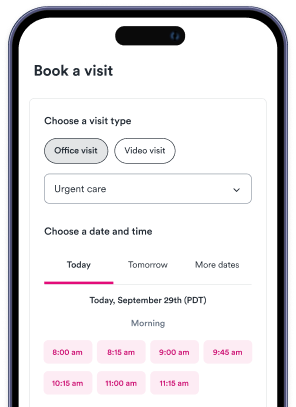
From the clinic or your couch. Find high quality, same-day urgent care for you and your kids. Book an urgent care visit today.

The Family and Medical Leave Act (FMLA) allows eligible employees to take up to 12 weeks of unpaid, job-protected leave per year for qualifying health conditions. But to use FMLA, most employers require a medical certification completed by a licensed healthcare provider. If you're dealing with a health issue and your primary care doctor isn't available for weeks, you may be wondering whether urgent care can step in. The answer is yes — in the right circumstances.
The Department of Labor's FMLA regulations define who can provide medical certification broadly. Any "health care provider" as defined under FMLA — which includes doctors of medicine or osteopathy, nurse practitioners, physician assistants, and other licensed clinicians — is authorized to complete FMLA certification forms. The provider does not need to be a specialist or your long-term treating physician.
What matters more than who the provider is: the provider must have a legitimate clinical basis for certifying the condition. This means they must have evaluated and treated the patient for the condition being certified. A provider cannot certify a condition they've never assessed.
Urgent care is well positioned to certify FMLA for conditions that fall squarely within the scope of what urgent care sees and treats — conditions that are acute, episodic, or can be evaluated during a single visit:
For these conditions, the urgent care provider treated you, has clinical documentation, and can describe the nature of the condition, the expected duration, and the functional limitations — exactly what the FMLA certification form requires.
Complex, chronic, or ongoing conditions are generally better certified by the treating specialist or primary care physician who manages that condition. Examples where urgent care is the wrong fit:
In these cases, an urgent care provider typically lacks the clinical history to certify the condition accurately and may decline to complete paperwork for conditions they've never treated. This isn't a barrier — it's the provider making the right call. Your treating specialist has the records, the relationship, and the clinical basis to certify accurately.
If you plan to ask an urgent care provider to complete FMLA certification, a little preparation goes a long way:
FMLA regulations give healthcare providers up to 15 calendar days to return completed certification to the employee. Employers cannot demand same-day completion. This means even if you ask the provider to complete certification at your visit and they say they'll need a few days, that is entirely within the bounds of the law. Plan ahead when possible — don't bring FMLA paperwork to an urgent care visit the day before your leave begins and expect it to be completed on the spot, though some clinics may accommodate this.
No. Under FMLA regulations, employers are required to accept certification from any licensed healthcare provider whose scope of practice includes the condition being certified. The type of facility — urgent care, primary care, specialist's office — is not a basis for rejection. However, employers do have the right to request a second opinion (at their expense) from a provider they designate, and in some cases a third opinion if the first two conflict. The process and your rights are governed by 29 CFR Part 825, the Department of Labor's FMLA regulations.
If you need to be seen for a health condition and want to ask about FMLA certification, urgent care can handle both in one visit — provided the condition is within their scope to certify. Bring your HR-provided forms, ask at the start of the appointment, and confirm the clinic's paperwork turnaround time. Use Solv to find a nearby urgent care, book your appointment in advance, and complete digital paperwork before you arrive so the provider has your information and your visit can focus on your care.
Yes. Any licensed healthcare provider — including urgent care physicians and nurse practitioners — can complete FMLA medical certification if the condition they're certifying falls within their scope and they have a clinical basis for the certification. They cannot certify conditions they haven't evaluated.
The most common form is the WH-380-E (Certification of Health Care Provider for Employee's Serious Health Condition), which your HR department provides. Bring this completed by HR to your urgent care visit and ask the provider to complete the clinical sections.
It depends on the clinic's policy and the provider's workload. Some clinics complete paperwork at the time of visit; others ask for 5–10 business days. FMLA regulations give providers up to 15 business days to complete certification. Ask about the clinic's policy when scheduling.
If your condition is complex, chronic, or ongoing (like cancer treatment, serious mental health disorders, or recovery from major surgery), urgent care may decline to certify and refer you to your treating specialist. In these cases, your PCP or specialist is the right provider for FMLA certification.
Yes. If a licensed healthcare provider in a qualifying specialty completes the certification and it meets the FMLA definition of a 'serious health condition,' employers must accept it regardless of whether the provider is a specialist or urgent care physician. Employers may request a second opinion.
Your employer must give you written notice of what is missing and at least seven calendar days to fix it. Stay in contact with your provider and HR to avoid losing leave protections.
From the clinic or your couch. Find high quality, same-day urgent care for you and your kids. Book an urgent care visit today.

Medically reviewed
View this article's sources and history, and read more about Solv's Content Mission Statement, editorial process, and editorial team.
Solv has strict sourcing guidelines and relies on peer-reviewed studies, academic research institutions, and medical associations. We avoid using tertiary references.
Solv’s team of medical writers and experts review and update our articles when new information becomes available.
Written by Solv Editorial Team
Medically reviewed by: Dr. Rob Rohatsch, MD
Edited by Solv Editorial Team
Edited by Solv Editorial Team
Edited by Solv Editorial Team
Edited by Solv Editorial Team
Edited by Solv Editorial Team
From the clinic or your couch. Find high quality, same-day urgent care for you and your kids. Book an urgent care visit today.