Urgent care near me
Sane-day doctor visits
Feel better faster. Get care today.
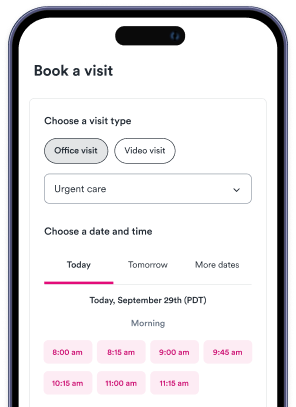
From the clinic or your couch. Find high quality, same-day urgent care for you and your kids. Book an urgent care visit today.
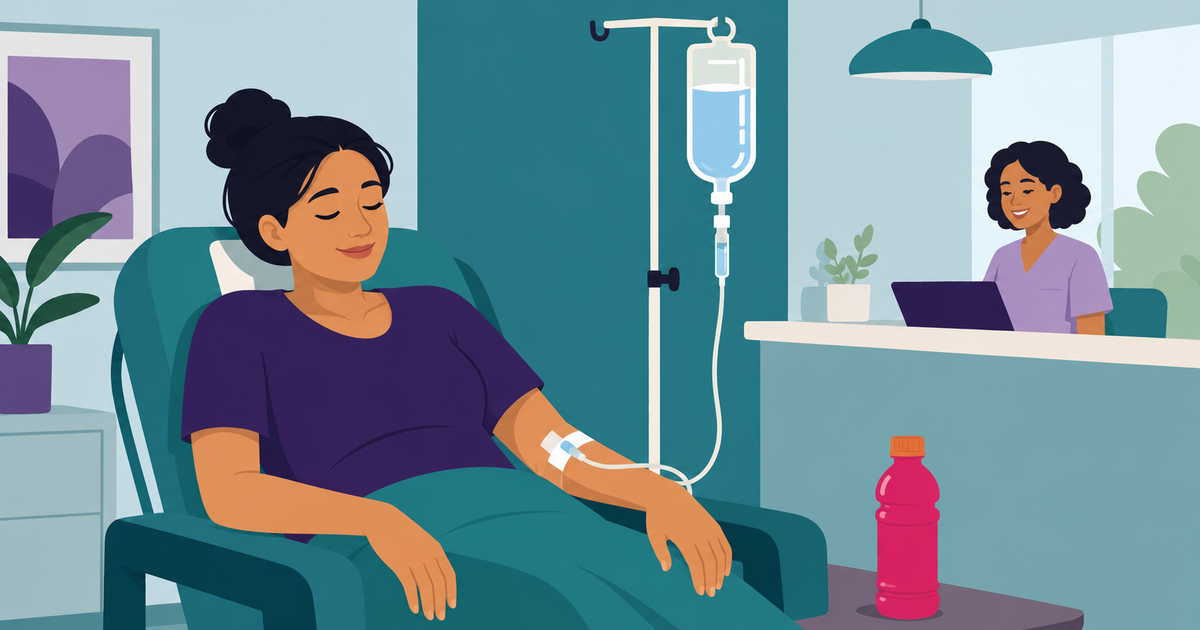
Yes — many urgent care clinics can give intravenous (IV) fluids for dehydration. The clinical question is usually whether you actually need IV fluids or whether oral rehydration is enough. Major guidelines from the American Academy of Pediatrics and the American Academy of Family Physicians recommend trying oral rehydration first for most mild to moderate dehydration; IV fluids are reserved for cases where oral rehydration cannot work.1,2
Dehydration is when your body loses more fluid than it takes in. Common causes include vomiting and diarrhea (the leading cause worldwide), high fever, heavy sweating in heat or during exercise, and conditions that increase urination such as uncontrolled diabetes.1,3
Mild to moderate dehydration may look like:
• Dry mouth, sticky saliva, or strong thirst
• Headache, fatigue, or dizziness when standing
• Decreased urine output, with dark yellow urine
• Reduced tear production in children
• Mild rapid heartbeat3
Severe dehydration is a medical emergency and can include confusion, fainting, racing heart, very low blood pressure, no urine output, sunken eyes, and lethargy — especially in infants and older adults.3
Many urgent care clinics — though not all — offer IV fluid therapy on site. Whether you receive an IV at urgent care depends on:
• The clinic's capability (some standalone urgent cares do not have nursing staff trained for IVs or do not stock IV supplies)
• Your degree of dehydration and ability to take oral fluids
• Whether your symptoms suggest a need for hospital-level care1,2
Call ahead or check the clinic's listed services if you need IV fluids specifically. On Solv, many urgent care locations list IV hydration as a service offering.
Per AAFP and AAP guidance, IV fluids are appropriate when:1,2
• You cannot keep down oral fluids despite anti-nausea medication
• You are moderately dehydrated and oral rehydration has failed
• You have signs of more severe dehydration (very low blood pressure, very fast pulse, near-fainting)
• You have an underlying condition that makes rapid rehydration important (older adult, pregnancy, chronic illness)
Oral rehydration with a balanced electrolyte solution (like Pedialyte or the WHO ORS) is the first-line treatment for mild to moderate dehydration. Studies cited by the AAFP show oral rehydration is as effective as IV fluids in most cases and avoids the pain, time, and rare complications of IV access.1,2,4
A typical urgent care IV visit looks like this:
1. Evaluation: Provider asks about symptoms, checks vitals (heart rate, blood pressure, temperature), and may run point-of-care labs (urine, glucose).
2. Anti-nausea medication first: If vomiting is the main barrier to drinking, you may be offered ondansetron (Zofran) or a similar medication. Many patients can then tolerate oral fluids and skip the IV entirely.2
3. IV placement: If oral rehydration is not feasible, a nurse cleans the skin, places a small catheter in a vein (usually in the forearm or hand), and connects an IV bag.
4. Infusion: Normal saline or lactated Ringer's solution is given over 30 to 90 minutes. A typical adult dose is 500 to 1,000 mL.
5. Reassessment: Vitals and symptoms are checked. Most people feel meaningfully better by the time the bag is empty.3
Some signs of dehydration belong in the emergency department, not urgent care. Call 911 or go to the ER for any of the following:
• Confusion, severe lethargy, or fainting
• No urine output for 8 or more hours
• Persistent vomiting that cannot be controlled with medication
• Severe abdominal pain or bloody stools
• Suspected severe electrolyte disturbance (muscle cramps, irregular heartbeat)
• Infants under 6 months with vomiting, diarrhea, or fewer than 6 wet diapers per day
• Anyone with signs of shock — pale or cool skin, rapid breathing, weak pulse2,3
Some urgent care clinics and standalone "IV bars" market wellness or vitamin drips for hangovers, fatigue, or athletic recovery. There is limited high-quality evidence that these mixtures provide benefits beyond the fluid component itself. AAFP's Choosing Wisely guidance emphasizes oral rehydration as the preferred first step in uncomplicated dehydration.2
If you are simply dehydrated from heat, alcohol, or exercise, water and an electrolyte drink will usually do the job. An IV is reasonable if you cannot keep fluids down — but it is not a routine recovery tool.
• Drink water consistently — pale yellow urine is a reasonable rule of thumb
• Replace fluids more aggressively during illness, heat exposure, and exercise
• Use an oral rehydration solution (Pedialyte, WHO ORS, or similar) for vomiting or diarrhea — plain water alone does not replace electrolytes
• Limit alcohol and high-sugar drinks during illness
• Older adults: drink on a schedule even without thirst, since thirst sensation declines with age3
If you are struggling to keep fluids down or have signs of moderate dehydration, find an urgent care or same-day clinic on Solv. Many clinics offer IV fluid therapy, and a provider can decide whether you need IV fluids, anti-nausea medication, or transfer to an ER.
A standard 1-liter bag of saline usually runs over 30 to 90 minutes, depending on how fast your provider sets the rate. Add 30 to 60 minutes for evaluation, IV placement, and reassessment, and you can expect about a 60- to 150-minute total visit.3
Out-of-pocket charges typically range from about $100 to $300 for the IV procedure and fluids, on top of the visit fee. Most commercial plans, Medicare, and Medicaid cover IV fluids when they are medically necessary. Elective wellness drips are generally not covered.1
Some pediatric-capable urgent care centers can place IVs in children, but many cannot — pediatric IV access is technically harder. The AAP strongly recommends oral rehydration first, and ondansetron (an anti-nausea medicine) often lets children rehydrate by mouth and avoid an IV entirely.2,5
For dehydration, urgent care providers most often give normal saline (0.9% sodium chloride) or lactated Ringer's solution. Both are balanced salt solutions that replace lost water and electrolytes. If labs show a specific electrolyte problem, additional ingredients may be added.3
Some clinics offer this as an out-of-pocket service, but routine wellness drips for hangovers are usually elective and not covered by insurance. Most hangover symptoms respond to water, electrolytes, food, and rest, with no measurable advantage from an IV in otherwise healthy adults.1
Often, yes. Many urgent care providers will check a urine sample, blood glucose, or basic metabolic panel before or during IV treatment — especially if you have diabetes, kidney disease, are over 65, or are pregnant. This helps tailor the right fluid and rate.2,3
From the clinic or your couch. Find high quality, same-day urgent care for you and your kids. Book an urgent care visit today.

Medically reviewed
View this article's sources and history, and read more about Solv's Content Mission Statement, editorial process, and editorial team.
Solv has strict sourcing guidelines and relies on peer-reviewed studies, academic research institutions, and medical associations. We avoid using tertiary references.
Solv’s team of medical writers and experts review and update our articles when new information becomes available.
Written by Solv Editorial Team
Medically reviewed by: Dr. Rob Rohatsch, MD
Edited by Solv Editorial Team
Edited by Solv Editorial Team
Edited by Solv Editorial Team
Edited by Solv Editorial Team
Edited by Solv Editorial Team
Edited by Solv Editorial Team
Edited by Solv Editorial Team
Edited by Solv Editorial Team
Edited by Solv Editorial Team
From the clinic or your couch. Find high quality, same-day urgent care for you and your kids. Book an urgent care visit today.