Urgent care near me
Sane-day doctor visits
Feel better faster. Get care today.
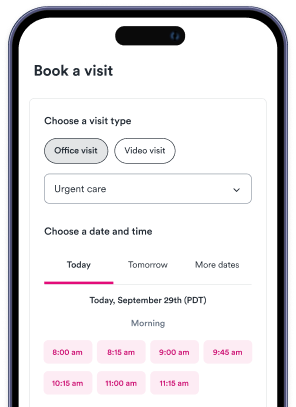
From the clinic or your couch. Find high quality, same-day urgent care for you and your kids. Book an urgent care visit today.

If you've ever opened a bill from an urgent care clinic and noticed the copay was higher than what your primary care doctor charges, you're not imagining it. Most insurance plans place urgent care in its own cost-sharing tier — between primary care and the emergency room — and that tier usually carries a higher out-of-pocket cost than a routine office visit.1,2
Almost every health plan defines specific cost-sharing for different types of visits. A typical breakdown looks like:
The U.S. Centers for Medicare & Medicaid Services lists the office-visit copay as a baseline cost-sharing amount that varies by plan and provider category.1 Your specific copays are listed in your plan's Summary of Benefits and Coverage.
Three factors drive the higher copay:
Even at the higher tier, urgent care is far less expensive than emergency care for the same low-acuity issues. Multiple studies of insurance claims show that ER visits for low-acuity conditions cost several times more than the same care delivered in an urgent care setting.3,4 The difference reflects ER overhead — 24/7 staffing, trauma capability, and a cost structure designed for true emergencies.5
If you have a non-emergency condition, urgent care almost always saves money over the ER, even when the urgent care copay feels high.
The copay listed on your insurance card isn't always the total you'll pay. Several factors can change the amount you owe:
For patients dealing with lingering congestion and pressure, urgent care can be a convenient first stop — our guide to urgent care for sinus infections explains what treatment looks like.
If a sore throat is severe or persists beyond a few days, it's worth getting a rapid strep test — see our guide on urgent care for strep throat for what to expect.
Urgent care is the right choice when you have a non-emergency condition that can't wait for a primary care appointment: minor injuries, infections, mild allergic reactions, sprains, or illnesses with worsening symptoms. For routine issues that can wait, your PCP usually offers the lowest cost. For symptoms suggesting a heart attack, stroke, severe bleeding, or trouble breathing, go to the ER or call 911.
If you're trying to keep costs down, look up your plan's urgent care tier before you go and search Solv for in-network clinics near you. Filter by accepted insurance, see upfront pricing, and book a same-day visit — you'll know what to expect before you walk in.
Most insurance plans tier urgent care between primary care (lowest copay) and the ER (highest), reflecting that urgent care has expanded hours, walk-in capacity, on-site labs, and on-site imaging. Plans price that convenience and capability higher than a scheduled PCP visit.
Possibly. A copay covers the office visit, but additional charges may apply for X-rays, labs, sutures, IV fluids, prescriptions, or procedures. If you have a deductible-based plan and haven't met your deductible yet, you may be charged the full negotiated rate, not just a copay. Ask the front desk what services you're being charged for.
For non-life-threatening issues, urgent care is almost always less expensive. Median ER visits cost several times more than urgent care — even when the underlying issue is the same. The ER is the right choice for chest pain, stroke symptoms, severe trauma, difficulty breathing, or any condition that could escalate quickly.
Most ACA-compliant plans cover urgent care under the same network rules as other in-network services. Coverage details — copay vs. coinsurance, deductible, in-network status, and prior authorization — vary by plan. Call the number on your insurance card before the visit, or ask the urgent care to verify your benefits when you check in.
Confirm in-network status, ask whether procedures are billed separately, request the cash-pay rate if you're uninsured (often less than insurance-billed), and ask if your visit could be handled with telemedicine for a lower copay. If you receive a surprise bill, ask the clinic for an itemized statement and call your insurer to dispute any charges that seem inconsistent with your benefits.
No. Prices vary by region, ownership (independent vs. hospital-affiliated), and services offered. Hospital-affiliated urgent care often costs more because it can bill a facility fee on top of the visit charge. Independent and retail clinics tend to have lower copays and cash rates.
From the clinic or your couch. Find high quality, same-day urgent care for you and your kids. Book an urgent care visit today.

Medically reviewed
View this article's sources and history, and read more about Solv's Content Mission Statement, editorial process, and editorial team.
Solv has strict sourcing guidelines and relies on peer-reviewed studies, academic research institutions, and medical associations. We avoid using tertiary references.
Solv’s team of medical writers and experts review and update our articles when new information becomes available.
Written by Solv Editorial Team
Medically reviewed by: Dr. Rob Rohatsch, MD
Edited by Solv Editorial Team
Edited by Solv Editorial Team
Edited by Solv Editorial Team
Edited by Solv Editorial Team
Edited by Solv Editorial Team
From the clinic or your couch. Find high quality, same-day urgent care for you and your kids. Book an urgent care visit today.