Urgent care near me
Sane-day doctor visits
Feel better faster. Get care today.
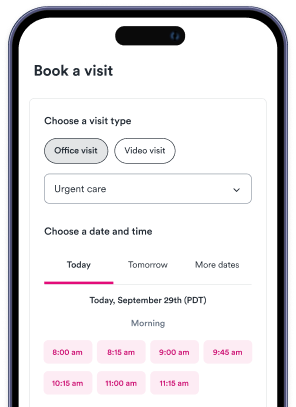
From the clinic or your couch. Find high quality, same-day urgent care for you and your kids. Book an urgent care visit today.

If you have a non-emergency health issue and can't get into your primary care doctor, you usually have two faster options: a telemedicine visit or a trip to urgent care. The right choice depends on what's wrong, how soon you need answers, and whether you need anything physical — an exam, imaging, or a procedure — to get diagnosed.1,2
Telemedicine — also called telehealth or virtual care — connects you with a provider by video, phone, or messaging. It's most effective for issues that can be evaluated through conversation and a visual check, including:
The HHS Office for the Advancement of Telehealth notes that telemedicine is well-suited to non-urgent issues that don't require a physical exam.1 Studies of large patient populations have also shown that virtual urgent care is associated with lower downstream healthcare utilization compared to ER-initiated care for the same low-acuity conditions.3
Urgent care is the right call any time you need a hands-on exam, in-clinic testing, or a procedure. That includes:
Studies of in-person urgent care have shown it's effective for low-acuity conditions that need physical evaluation but don't rise to ER level.4
For most insured patients, telemedicine costs less than urgent care. Common ranges:
If your deductible isn't met, your plan may apply the full negotiated rate to either visit. Confirm with your insurer or the provider's portal before you book.
On-demand telemedicine platforms can usually connect you with a provider in minutes. Walk-in or booked urgent care wait times are typically 15–45 minutes once you arrive, plus the drive. If you book your urgent care visit online via Solv, you can often skip most of the in-clinic wait.
For after-hours coverage, telemedicine's 24/7 availability is hard to beat. Most urgent care clinics close in the late evening, so a virtual visit may be your only option overnight.
Multiple peer-reviewed analyses of virtual urgent care have shown that, when used for the right conditions, virtual care yields outcomes comparable to in-person urgent care.5,6 The caveat is matching the visit type to the problem. Telemedicine for an issue that really needs an exam can lead to a missed diagnosis or a second visit — which costs you both time and money.
Try telemedicine first if: you can describe and show your symptoms over video, you don't need imaging or lab work, and you're seeking advice, a prescription, or a routine follow-up.
Go to urgent care if: you suspect a fracture, have a wound that may need stitches, are dehydrated, have a fever with concerning symptoms, or have any issue your telemedicine provider can't resolve confidently.
Go to the ER or call 911 if: you have chest pain, signs of stroke, severe trouble breathing, severe injury, sudden severe headache, severe abdominal pain, suspected heart attack, severe allergic reaction, or thoughts of self-harm.2
Solv lets you book both telemedicine visits and same-day urgent care visits in one place. If you start with telemedicine and the provider determines you need hands-on care, you can transition to an in-person visit at a partner clinic without starting over. Search your zip code on Solv to compare wait times and prices side by side.
Yes. Telemedicine providers can prescribe most medications — antibiotics, antivirals, allergy medications, contraception, and routine refills. Controlled substances (most ADHD medications, opioids, benzodiazepines) face stricter rules and may not be prescribed virtually depending on your state and the platform's policies.
Coverage varies by plan, but most ACA-compliant plans now cover telemedicine. Many charge a lower copay than for in-person urgent care — sometimes $0. Call your insurer or check your member portal to confirm. If your telemedicine visit ends in a referral, the in-person visit may have its own separate cost-sharing.
Most telemedicine visits last 10–20 minutes once you connect with a provider. Wait times to see a provider vary by platform — some on-demand services connect within minutes, while scheduled visits may run later in the day. Urgent care wait times average 15–45 minutes, but include the time to drive there and check in.
Anything that requires a physical exam, listening to your heart or lungs, palpation, imaging, lab work, or a procedure. That includes suspected fractures, deep cuts needing stitches, abdominal pain that may be appendicitis, severe ear infections, and anything that may require IV fluids. If your provider can't make a confident diagnosis on video, they will refer you to in-person care.
For straightforward issues — pink eye, mild rashes, simple cold symptoms, behavior questions — telemedicine works well for kids and many pediatric platforms specialize in it. For fever in infants under 3 months, persistent vomiting, breathing difficulty, dehydration, or anything that worries you, see in-person care. Pediatric urgent care is faster than the ER for non-emergencies.
Call 911 or go to the ER for chest pain, signs of stroke (facial droop, slurred speech, weakness on one side), severe trouble breathing, sudden severe headache, suspected heart attack, severe bleeding, deep wounds, head injury with confusion, severe allergic reaction (anaphylaxis), or thoughts of harming yourself. Telemedicine and urgent care are not equipped for true emergencies.
From the clinic or your couch. Find high quality, same-day urgent care for you and your kids. Book an urgent care visit today.

Medically reviewed
View this article's sources and history, and read more about Solv's Content Mission Statement, editorial process, and editorial team.
Solv has strict sourcing guidelines and relies on peer-reviewed studies, academic research institutions, and medical associations. We avoid using tertiary references.
Solv’s team of medical writers and experts review and update our articles when new information becomes available.
Written by Solv Editorial Team
Medically reviewed by: Dr. Rob Rohatsch, MD
Edited by Solv Editorial Team
Edited by Solv Editorial Team
Edited by Solv Editorial Team
Edited by Solv Editorial Team
Edited by Solv Editorial Team
From the clinic or your couch. Find high quality, same-day urgent care for you and your kids. Book an urgent care visit today.