Urgent care near me
Sane-day doctor visits
Feel better faster. Get care today.
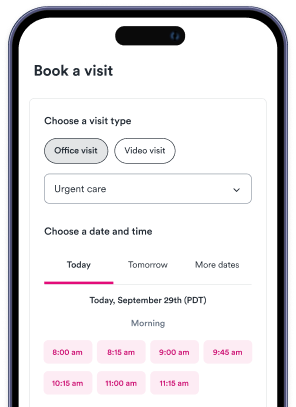
From the clinic or your couch. Find high quality, same-day urgent care for you and your kids. Book an urgent care visit today.

You're not sure if that chest tightness is anxiety or something worse. Your kid has a 103°F fever at 9 p.m. You twisted your ankle stepping off a curb. When something hurts or worries you, the instinct is often to go to the nearest ER — but for many conditions, that choice leads to a longer wait and a much larger bill. Knowing when urgent care is sufficient, and when the emergency room is truly necessary, can save you time, money, and stress.
Urgent care centers occupy the space between a scheduled primary care appointment and a hospital emergency department. They're built for conditions that need attention today — not next week — but don't require trauma bays, surgical teams, or advanced critical care equipment. Most clinics are staffed by physicians, physician assistants, or nurse practitioners, and carry on-site X-ray, basic labs, and the ability to perform minor procedures like suturing and casting.
Conditions urgent care handles well include:
Research published in Academic Emergency Medicine estimated that between 13% and 27% of all emergency department visits could safely be managed at an urgent care center instead — a significant and costly mismatch between where patients seek care and where their condition actually requires it.
Emergency departments are staffed by emergency physicians backed by surgical teams, advanced imaging (CT, MRI, angiography), cardiac monitoring, and intensive care capabilities. Those resources exist because some conditions cannot wait, cannot be transferred, and cannot be stabilized with what urgent care has available. Go directly to an ER — or call 911 — if you or someone near you experiences:
The CDC notes that heart attack and stroke symptoms require immediate 911 response — time-sensitive treatments like clot-busting drugs and cardiac catheterization can only be administered in a hospital setting. The American College of Emergency Physicians cautions that time lost in a transfer from urgent care to a hospital can worsen outcomes for these patients.
For non-emergency conditions, the cost difference between urgent care and the ER is significant. A study published in Health Affairs found substantially higher prices at hospital emergency departments compared to urgent care centers for the same low-acuity services, even after controlling for patient complexity. Out of pocket, urgent care visits typically run $150–$280 without insurance, while ER visits for a similar non-emergency condition can exceed $1,000–$2,500 before additional lab or imaging fees.
Wait times follow the same pattern. Urgent care centers typically see patients within 15–45 minutes. Because hospital ERs triage by severity, a non-urgent case will always yield to a cardiac event or trauma — median wait times for low-acuity ER visits often exceed two hours.
For insured patients, urgent care copays typically run $25–$75, while ER cost-sharing commonly starts at $150–$350 before coinsurance kicks in on any additional services.
If your condition is painful or worrying but not life-threatening, urgent care is almost always the faster, lower-cost option. You can find urgent care clinics near you on Solv, compare wait times, and check in online before you leave home — so you spend less time in a waiting room and more time getting better.
Urgent care centers treat non-life-threatening conditions like infections, minor injuries, and fever. Emergency rooms handle life-threatening emergencies including chest pain, stroke, severe trauma, and conditions requiring surgery or intensive care.
Yes. The average urgent care visit costs $150–$280 without insurance. An ER visit for a similar non-emergency condition typically runs $1,000–$2,500 or more, plus additional charges for labs, imaging, and facility fees.
Urgent care can evaluate and treat non-displaced (simple) fractures. Most clinics have on-site X-ray and can apply splints or casts. Compound fractures or breaks requiring surgery should be treated in an emergency room.
Chest pain, signs of stroke (sudden facial drooping, arm weakness, slurred speech), difficulty breathing, loss of consciousness, uncontrolled bleeding, severe head injury, suspected poisoning or overdose, and fever in infants under 3 months always warrant an ER visit or 911 call.
Yes — walk-in visits are a core feature of urgent care. Many clinics also offer online check-in so you can hold your place in line before arriving, reducing your wait time.
In most cases, insurance will cover visits to both urgent care centers and emergency rooms. However, co-pays may be higher for emergency rooms, and some visits may not be covered if they are deemed unnecessary or if the facility is out-of-network.
From the clinic or your couch. Find high quality, same-day urgent care for you and your kids. Book an urgent care visit today.

Medically reviewed
View this article's sources and history, and read more about Solv's Content Mission Statement, editorial process, and editorial team.
Solv has strict sourcing guidelines and relies on peer-reviewed studies, academic research institutions, and medical associations. We avoid using tertiary references.
Solv’s team of medical writers and experts review and update our articles when new information becomes available.
Written by Solv Editorial Team
Medically reviewed by: Dr. Rob Rohatsch, MD
Edited by Solv Editorial Team
Edited by Solv Editorial Team
Edited by Solv Editorial Team
Edited by Solv Editorial Team
Edited by Solv Editorial Team
Edited by Solv Editorial Team
From the clinic or your couch. Find high quality, same-day urgent care for you and your kids. Book an urgent care visit today.