Urgent care near me
Sane-day doctor visits
Feel better faster. Get care today.
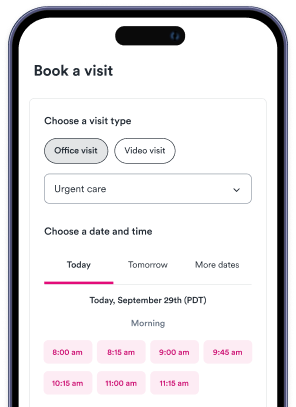
From the clinic or your couch. Find high quality, same-day urgent care for you and your kids. Book an urgent care visit today.

Yes — most urgent care clinics can test for Lyme disease. They can collect a blood sample for CDC-recommended two-tier antibody testing, evaluate symptoms and exposure history, and prescribe antibiotics when appropriate. Results from confirmatory testing usually come back within a few days, though early Lyme disease is often diagnosed and treated based on clinical findings before serology turns positive.1,2
Lyme disease is the most commonly reported vector-borne illness in the United States. It is caused by the bacterium Borrelia burgdorferi and, less often, Borrelia mayonii, transmitted to humans through the bite of an infected blacklegged (deer) tick.1
Early symptoms typically appear 3 to 30 days after a tick bite and may include:
• A circular, expanding rash called erythema migrans (often a "bull's eye" pattern) at the bite site
• Fever, chills, headache, fatigue, and muscle or joint aches
• Swollen lymph nodes
If untreated, infection can spread to the joints, heart, and nervous system over weeks to months.1
Yes. Urgent care clinics can draw blood for Lyme antibody testing and send the sample to a partner laboratory for processing. They can also examine any rash, take a tick exposure history, and assess for symptoms that suggest disseminated infection (joint swelling, facial weakness, irregular heartbeat).2,3
Most urgent care providers cannot run Lyme tests in-house — the assays are processed at reference labs. Standard turnaround is one to several business days. If you bring the tick in, some clinics can identify the species, but the CDC does not recommend routinely testing ticks for Borrelia, because a positive tick result does not reliably predict human infection.1
The CDC recommends a two-tier blood testing approach for Lyme disease. Both tests can be run on the same blood sample.2,3
Tier 1: A sensitive enzyme immunoassay (EIA), or less commonly an immunofluorescence assay (IFA), screens for antibodies to Borrelia burgdorferi. If the first-tier test is negative, no further testing is needed and Lyme disease is unlikely.2
Tier 2: If the first-tier test is positive or equivocal, a confirmatory test is run. Two options are accepted:
• Standard two-tiered testing (STTT): A western immunoblot (IgM and/or IgG) is used as the confirmatory test.3
• Modified two-tiered testing (MTTT): Since 2019, the FDA has cleared assays that use a second EIA instead of a western blot. The CDC recognizes MTTT as equivalent in performance.2,3
Lyme antibody tests work well after the body has had time to mount an immune response — typically 2 to 6 weeks after infection. They are not reliable in the first few weeks, when antibodies have not yet developed. Early Lyme disease should therefore be diagnosed clinically (rash, symptoms, tick exposure), not by serology alone.2
The CDC notes additional pitfalls:
• A positive IgM result should be disregarded if symptoms have lasted more than 30 days, because IgM rises early and can produce false positives later.2
• Antibodies can persist for months or years after successful treatment, so a positive test does not necessarily indicate active infection.2
• Tests cleared by the FDA are recommended; non-FDA-cleared "alternative" Lyme tests are not endorsed by the CDC.2
If you have a recognizable erythema migrans rash plus exposure to an area where Lyme disease is common, current guidelines recommend starting antibiotic treatment immediately — without waiting for serology — because the rash alone is enough to diagnose early Lyme disease.1,4
Doxycycline is the first-line oral antibiotic for early Lyme disease in adults and children of all ages. The Infectious Diseases Society of America, American Academy of Neurology, and American College of Rheumatology jointly endorse a 10- to 14-day course for typical early disease. Alternatives (amoxicillin, cefuroxime) are used when doxycycline is not appropriate.4
Some Lyme disease complications need higher-level care than urgent care can provide. Go to an emergency room or call 911 if you have:
• Severe headache with stiff neck or confusion
• New facial weakness or drooping (Bell's palsy can be a sign of neurologic Lyme)
• Chest pain, palpitations, fainting, or shortness of breath (possible Lyme carditis)
• Severe, swollen joints with high fever
• Severe allergic reaction to a tick bite or antibiotic1
To help your urgent care visit go quickly, bring:
• A clear photo of any rash, including a ruler or coin for scale
• Information about where and when you may have been exposed to ticks
• The tick itself, if you saved it (in a sealed bag or container)
• A list of current medications and known allergies
The CDC recommends standard tick precautions whenever you are in grassy or wooded areas:
• Use EPA-registered repellents containing DEET, picaridin, IR3535, oil of lemon eucalyptus, or 2-undecanone
• Treat clothing and gear with 0.5% permethrin
• Walk in the center of trails and avoid brushy vegetation
• Check yourself, your children, and pets for ticks within 2 hours of coming indoors and shower as soon as possible
• Remove attached ticks promptly with fine-tipped tweezers1
If you have a tick exposure, a new rash, or unexplained fever and fatigue after time outdoors, do not wait. Find an urgent care or same-day clinic on Solv to get evaluated, tested, and started on treatment if needed.
Most urgent care clinics send Lyme antibody testing to a partner laboratory. Standard turnaround is 1 to 5 business days. Some larger urgent care groups offer expedited processing. Confirm the timing with your clinic when the sample is drawn.2
Testing immediately after a tick bite is usually not helpful. Antibodies take 2 to 6 weeks to develop, so a test in the first few weeks may be falsely negative. If you have a typical erythema migrans rash, treatment is usually started without waiting for the test.1,4
Yes, if your clinical picture is consistent with early Lyme disease — for example, a bull's-eye rash with tick exposure in an endemic area. Doxycycline is the first-line antibiotic and is started empirically when clinical suspicion is high.4
Most commercial insurance plans and Medicare cover CDC-recommended Lyme testing when it is medically indicated. Costs vary by plan and laboratory. Some alternative or non-FDA-cleared tests are not covered. Ask your urgent care or check your benefits before ordering specialty assays.2
You can — putting the tick in a sealed plastic bag or container can help with identification. The CDC does not, however, recommend routinely testing the tick for Borrelia, because a positive tick result does not reliably mean human infection has occurred.1
Some patients have lingering fatigue, pain, or cognitive symptoms after standard treatment — sometimes called post-treatment Lyme disease syndrome. Long-term antibiotic therapy is not supported by current evidence and is not recommended by major guidelines. Persistent symptoms should be evaluated by a primary care provider or infectious disease specialist.4
From the clinic or your couch. Find high quality, same-day urgent care for you and your kids. Book an urgent care visit today.

Medically reviewed
View this article's sources and history, and read more about Solv's Content Mission Statement, editorial process, and editorial team.
Solv has strict sourcing guidelines and relies on peer-reviewed studies, academic research institutions, and medical associations. We avoid using tertiary references.
Solv’s team of medical writers and experts review and update our articles when new information becomes available.
Written by Solv Editorial Team
Medically reviewed by: Dr. Rob Rohatsch, MD
Edited by Solv Editorial Team
Edited by Solv Editorial Team
Edited by Solv Editorial Team
Edited by Solv Editorial Team
Edited by Solv Editorial Team
Edited by Solv Editorial Team
Edited by Solv Editorial Team
Edited by Solv Editorial Team
From the clinic or your couch. Find high quality, same-day urgent care for you and your kids. Book an urgent care visit today.