Urgent care near me
Sane-day doctor visits
Feel better faster. Get care today.
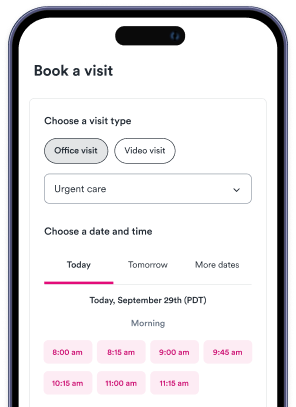
From the clinic or your couch. Find high quality, same-day urgent care for you and your kids. Book an urgent care visit today.

Yes — urgent care clinics can evaluate and treat most hemorrhoids. Providers can examine the area, confirm the diagnosis, drain a painful thrombosed external hemorrhoid, prescribe medications, and tell you when conservative care is enough versus when you need a colorectal specialist or the emergency room.1,2
Hemorrhoids are swollen veins in the lower rectum and anus. About 1 in 20 Americans has hemorrhoids, and roughly half of adults over age 50 will have them at some point.1 They are classified by location:
Internal hemorrhoids form inside the rectum. They usually do not hurt because that tissue has few pain-sensing nerves, but they can bleed during bowel movements or prolapse (push through the anal opening).1
External hemorrhoids develop under the skin around the anus. They can itch, hurt, and form a hard, painful lump when a blood clot develops inside — a condition called a thrombosed external hemorrhoid.1,3
Yes. Urgent care is a reasonable first stop for most hemorrhoid symptoms. A clinician can perform a visual inspection and a digital rectal exam to confirm the diagnosis, rule out more serious causes of rectal bleeding, and start treatment the same day.2,3
Typical urgent care care includes:
• Recommending conservative measures such as a high-fiber diet, more fluids, stool softeners, sitz baths, and over-the-counter hemorrhoid creams or suppositories — the NIDDK notes most people improve within a week of starting these steps.2
• Prescribing stronger topical preparations (steroid creams, lidocaine) or oral pain relievers when over-the-counter options are not enough.3
• Draining a thrombosed external hemorrhoid. If the clot is causing significant pain and you arrive within about 72 hours of onset, a clinician can numb the area and remove the clot through a small incision. This procedure provides rapid relief.3
Consider urgent care if you have any of the following and cannot get a same-day appointment with your primary care provider:
• A new, painful lump near the anus
• Bleeding with bowel movements that is small in volume but new or persistent
• Itching, swelling, or burning that has not improved with home care after several days
• Mucus discharge or a feeling that you cannot empty your bowels completely
• A hemorrhoid that has prolapsed and will not push back in1,2
Severe symptoms can signal a complication that needs hospital-level care. Go to the emergency room or call 911 if you have:
• Heavy rectal bleeding — soaking through underwear or filling the toilet bowl
• Dizziness, lightheadedness, weakness, or fainting
• Severe rectal or abdominal pain
• Fever, chills, or signs of infection at the site
• Black, tarry stools or vomiting blood (these can indicate bleeding higher in the gastrointestinal tract)2,4
For most patients, the AAFP recommends starting with conservative therapy: a high-fiber diet (25 to 35 grams per day), adequate hydration, sitz baths twice daily, and topical agents. About 80% of patients respond to these measures within a few weeks.3
If symptoms persist or hemorrhoids are larger, in-office procedures performed by a colorectal specialist or gastroenterologist are typically next:
• Rubber band ligation places a small rubber band around the base of an internal hemorrhoid to cut off blood supply. It is the most common office-based treatment.2
• Sclerotherapy injects a solution that shrinks the hemorrhoid.2
• Infrared photocoagulation uses heat to scar and shrink the hemorrhoid.2
Surgery (hemorrhoidectomy) is reserved for large, painful, or recurrent hemorrhoids that do not respond to less invasive options.3
A thrombosed external hemorrhoid is one of the most common reasons people seek urgent care for anal complaints. It presents as a sudden, severely painful bluish lump at the anal opening. The pain typically peaks in 48 to 72 hours and gradually improves over the next two weeks as the clot resorbs.3
If you arrive within the first 72 hours, your provider can offer surgical excision under local anesthesia, which usually provides immediate relief. After 72 hours, conservative therapy is usually preferred because the clot is already being reabsorbed and the pain is improving on its own.3
Many hemorrhoids are tied to chronic straining and constipation. To reduce your risk:
• Eat 25 to 35 grams of fiber daily from fruits, vegetables, whole grains, and legumes
• Drink enough water that your urine is pale yellow
• Do not delay going to the bathroom when you feel the urge
• Avoid prolonged sitting on the toilet or straining
• Stay physically active — regular exercise supports bowel regularity1,2
If you are dealing with painful hemorrhoid symptoms, you do not need to wait. Find an urgent care or same-day clinic on Solv to get evaluated, get a prescription if needed, and learn whether conservative care is enough or whether you should follow up with a specialist.
Yes — most urgent care clinics can numb the area and surgically excise a thrombosed external hemorrhoid if you arrive within about 72 hours of the lump forming. After 72 hours, conservative care is usually preferred because the clot is already starting to be reabsorbed and the procedure offers less benefit.3
Urgent care providers can prescribe topical steroids, prescription-strength numbing creams (such as lidocaine), and oral pain medication. They typically do not perform procedures like rubber band ligation, which is done by a colorectal specialist or gastroenterologist in a follow-up visit.3
Most commercial health plans, Medicare, and many Medicaid plans cover urgent care visits for hemorrhoid evaluation, similar to any other medically necessary visit. Co-pays for urgent care are usually lower than emergency room co-pays. Confirm in-network status with your plan if cost is a concern.
Most external hemorrhoid flare-ups improve within one to two weeks with conservative care. Internal hemorrhoids may bleed off and on for longer periods if the underlying causes — constipation, straining, low fiber intake — are not addressed. Persistent symptoms beyond a few weeks deserve a follow-up visit.2,3
No. Bleeding can also come from anal fissures, inflammatory bowel disease, polyps, or colorectal cancer. The NIDDK recommends that adults with new rectal bleeding be evaluated even when hemorrhoids are suspected, especially after age 45 or with family history of colorectal cancer.1
If your symptoms are recurrent, severe, or do not improve with conservative therapy within a few weeks, your urgent care provider will usually recommend follow-up with a primary care provider, gastroenterologist, or colorectal surgeon for office-based procedures or further evaluation.3
From the clinic or your couch. Find high quality, same-day urgent care for you and your kids. Book an urgent care visit today.

Medically reviewed
View this article's sources and history, and read more about Solv's Content Mission Statement, editorial process, and editorial team.
Solv has strict sourcing guidelines and relies on peer-reviewed studies, academic research institutions, and medical associations. We avoid using tertiary references.
Solv’s team of medical writers and experts review and update our articles when new information becomes available.
Written by Solv Editorial Team
Medically reviewed by: Dr. Rob Rohatsch, MD
Edited by Solv Editorial Team
Edited by Solv Editorial Team
Edited by Solv Editorial Team
Edited by Solv Editorial Team
Edited by Solv Editorial Team
Edited by Solv Editorial Team
Edited by Solv Editorial Team
From the clinic or your couch. Find high quality, same-day urgent care for you and your kids. Book an urgent care visit today.