Urgent care near me
Sane-day doctor visits
Feel better faster. Get care today.
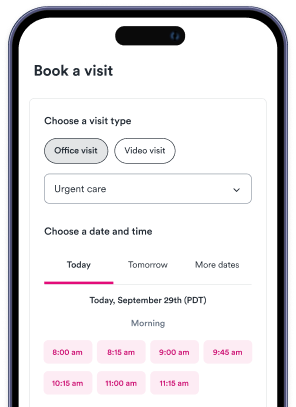
From the clinic or your couch. Find high quality, same-day urgent care for you and your kids. Book an urgent care visit today.

Urinary tract infections are among the most common bacterial infections in women — affecting roughly 50–60% of women at least once in their lifetime, according to the National Institutes of Health. The symptoms are usually hard to miss. But not every UTI is the same, and understanding the difference between a straightforward bladder infection and one that's heading toward the kidneys can help you decide how quickly you need care — and where to go.
A urinary tract infection can involve any part of the urinary system, but in women, most infections are lower tract infections — meaning they affect the urethra and bladder. The classic symptoms include:
These symptoms are caused by bacterial inflammation of the bladder lining. Escherichia coli (E. coli) accounts for the majority of UTIs — typically bacteria that are normally present in the gut and migrate to the urinary tract.
Female anatomy is the primary reason. Women have a shorter urethra than men, which means bacteria have a shorter distance to travel to reach the bladder. The urethral opening is also anatomically closer to both the vaginal and anal openings, increasing exposure to bacteria. Hormonal changes — particularly the decline in estrogen during menopause — can further increase susceptibility by altering the protective bacterial environment of the vaginal area.
Other factors that increase UTI risk include sexual activity, use of certain contraceptives (diaphragms or spermicide), a history of UTIs, and urinary tract abnormalities.
Seeing blood in your urine when you have UTI symptoms is frightening but not unusual. Hemorrhagic cystitis — a bladder infection that causes bleeding — is a known presentation of UTI. In the context of classic UTI symptoms, blood in the urine typically indicates a more inflamed bladder infection, not a separate or more dangerous condition. It still requires prompt antibiotic treatment. However, blood in the urine without other UTI symptoms, or persistent hematuria after treatment, warrants further evaluation to rule out other causes.
If bacteria travel up from the bladder into the ureters and reach the kidneys, the infection becomes pyelonephritis — a kidney infection. This is a more serious condition that requires more aggressive antibiotic treatment and sometimes hospitalization. The key signs that a UTI has progressed to a kidney infection include:
These symptoms require same-day care. If you're experiencing UTI symptoms along with fever and flank pain, don't wait — go to urgent care or the ER depending on the severity of your symptoms.
Diagnosis is straightforward. A urinalysis — a simple urine test — detects white blood cells, red blood cells, bacteria, and other markers of infection. Urgent care can perform this test on-site and have results within 30–60 minutes. A urine culture (sent to a lab) identifies the specific bacteria and antibiotic sensitivities, but treatment typically begins before culture results return.
Antibiotics are the standard treatment. Common first-line options include nitrofurantoin, trimethoprim-sulfamethoxazole, and fosfomycin, though the right choice depends on local resistance patterns and individual health factors. Most women feel significantly better within 24–48 hours of starting antibiotics — but completing the full course is important even after symptoms improve.
Over-the-counter phenazopyridine (Azo) can relieve the burning sensation while you wait for antibiotics to work, but it is a pain reliever, not an antibiotic — it will turn your urine orange and does not treat the underlying infection.
For women who experience recurrent UTIs (three or more per year), prevention is worth discussing with a provider. Evidence-based strategies include:
If you have classic UTI symptoms — burning with urination, urgency, cloudy urine — urgent care can diagnose and treat you the same day without an appointment at your primary care doctor. Book on Solv to find a nearby urgent care, complete your paperwork in advance, and get antibiotics started quickly. If you have a fever, chills, or flank pain alongside your UTI symptoms, seek care immediately — those signs suggest a kidney infection that needs prompt attention.
The earliest symptoms are usually a burning sensation during urination and a frequent, urgent need to urinate — even when little urine comes out. The urine may look cloudy or smell strong. Some women also experience pelvic discomfort or pressure in the lower abdomen.
In most cases, no. UTIs are bacterial infections that require antibiotic treatment to clear fully. While some very mild UTIs in healthy young women may resolve with aggressive fluid intake and rest, the risk of the infection ascending to the kidneys makes treatment important. Most providers recommend antibiotics for diagnosed UTIs.
A UTI typically involves the bladder and urethra. A kidney infection (pyelonephritis) occurs when bacteria travel from the bladder up to the kidneys, producing systemic symptoms: fever above 101°F, shaking chills, flank pain (pain in your side or back below the ribs), and nausea or vomiting in addition to urinary symptoms. Kidney infections require more aggressive antibiotic treatment and sometimes IV antibiotics.
Urgent care can perform a urinalysis on-site and get results within 30–60 minutes. If the urinalysis is consistent with a UTI, antibiotics can be prescribed the same day. Many patients feel significant relief within 24–48 hours of starting treatment.
Evidence-based prevention strategies include staying well hydrated, urinating after sexual activity, wiping front to back, avoiding irritating products in the genital area, and in some cases, low-dose preventive antibiotics prescribed by a provider. Women with three or more UTIs per year benefit from a more thorough evaluation.
From the clinic or your couch. Find high quality, same-day urgent care for you and your kids. Book an urgent care visit today.

Dr. Linda Halbrook is a Board-Certified Family Medicine physician with over 40 years of experience, dedicated to providing comprehensive care to patients across Texas. She retired from practice but currently serves on the Clinical Services Committee of CommonGood Medical, a non-profit organization serving the uninsured in Collin County.
Medically reviewed
View this article's sources and history, and read more about Solv's Content Mission Statement, editorial process, and editorial team.
Solv has strict sourcing guidelines and relies on peer-reviewed studies, academic research institutions, and medical associations. We avoid using tertiary references.
Solv’s team of medical writers and experts review and update our articles when new information becomes available.
Written by Solv Editorial Team
Medically reviewed by: Dr. Rob Rohatsch, MD
Medically reviewed by: Justin Bowles, MD, FAWM, DiMM
Medically reviewed by: Alicia Tezel, MD, FAAP, FCUCM
Medically reviewed by: Alicia Tezel, MD, FAAP, FCUCM
Medically reviewed by: Alicia Tezel, MD, FAAP, FCUCM
Medically reviewed by: Alicia Tezel, MD, FAAP, FCUCM
Medically reviewed by: Alicia Tezel, MD, FAAP, FCUCM
Medically reviewed by: Linda S. Halbrook, MD
Edited by Solv Editorial Team
Edited by Solv Editorial Team
Edited by Solv Editorial Team
Edited by Solv Editorial Team
Edited by Solv Editorial Team
From the clinic or your couch. Find high quality, same-day urgent care for you and your kids. Book an urgent care visit today.