Urgent care near me
Sane-day doctor visits
Feel better faster. Get care today.
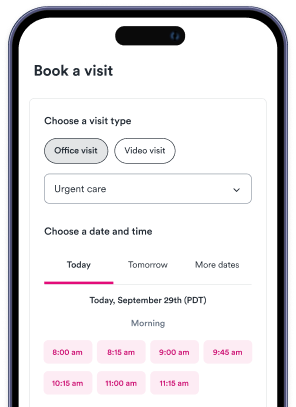
From the clinic or your couch. Find high quality, same-day urgent care for you and your kids. Book an urgent care visit today.

Gallstones are hardened deposits that form inside the gallbladder—a small, pear-shaped organ beneath the liver that stores bile, a digestive fluid. Bile contains cholesterol, bilirubin, and bile salts; when these components become imbalanced, they can crystallize and form stones ranging from the size of a grain of sand to a golf ball.1
There are two main types:
Gallstones are common—approximately 10–15% of adults in the United States have them—but most never cause symptoms.2
When a gallstone blocks a bile duct, even temporarily, it triggers a gallbladder attack (biliary colic). Symptoms include:3
Between attacks, most people feel completely well. The pain is not gradual—it comes on quickly and can be severe enough to be mistaken for a heart attack or appendicitis.
Some gallstone complications are serious and require emergency care. Go to the ER immediately if you have:4
Untreated gallbladder infection (acute cholecystitis) or bile duct blockage (choledocholithiasis) can become life-threatening within hours.
Urgent care can be appropriate for mild to moderate gallstone symptoms—particularly a first episode of abdominal pain that is not accompanied by fever, jaundice, or unbearable pain. At urgent care, a provider can:
If your symptoms include fever, jaundice, or severe unrelenting pain, skip urgent care and go directly to the emergency room.
Gallstones form when bile chemistry is out of balance. Known risk factors include:5
The standard first-line test is an abdominal ultrasound, which detects gallstones with greater than 95% accuracy and is painless and radiation-free.6 Additional tests may include:
Treatment depends on whether your gallstones are causing symptoms:7
The gallbladder is not essential for digestion. Most people adapt normally after it is removed and can eat a regular diet.
You can lower your gallstone risk with these evidence-based habits:
Gallstone pain (biliary colic) is typically a sudden, intense aching or pressure in the upper right abdomen or center of the stomach. It often radiates to the right shoulder or back between the shoulder blades. Pain usually peaks within an hour and can last 1–5 hours.
Small gallstones occasionally pass on their own, but most do not dissolve or disappear without treatment. "Silent" gallstones (those causing no symptoms) may never need treatment. Stones causing recurrent attacks typically require surgical removal.
Go to the ER if pain lasts more than 5 hours, you have fever or chills, your skin or eyes look yellow (jaundice), or you have nausea and vomiting you cannot control. Urgent care can evaluate milder symptoms, order imaging, and refer you to a specialist.
High-fat and high-cholesterol foods are common triggers—fried foods, fatty meats, full-fat dairy, butter, and rich sauces. Eating a large meal after fasting can also provoke an attack. A low-fat diet helps reduce the frequency of gallbladder attacks.
The primary diagnostic tool is abdominal ultrasound, which is highly accurate for detecting gallstones. Blood tests check for signs of infection or liver involvement. CT scans or HIDA scans may be used when ultrasound results are inconclusive or complications are suspected.
Not always. Silent gallstones (causing no symptoms) typically do not require treatment. If you have recurring painful attacks, your doctor will likely recommend laparoscopic cholecystectomy—removal of the gallbladder—which is safe, common, and usually performed as an outpatient procedure.
From the clinic or your couch. Find high quality, same-day urgent care for you and your kids. Book an urgent care visit today.

Dr. Linda Halbrook is a Board-Certified Family Medicine physician with over 40 years of experience, dedicated to providing comprehensive care to patients across Texas. She retired from practice but currently serves on the Clinical Services Committee of CommonGood Medical, a non-profit organization serving the uninsured in Collin County.
Medically reviewed
View this article's sources and history, and read more about Solv's Content Mission Statement, editorial process, and editorial team.
Solv has strict sourcing guidelines and relies on peer-reviewed studies, academic research institutions, and medical associations. We avoid using tertiary references.
Solv’s team of medical writers and experts review and update our articles when new information becomes available.
Written by Solv Editorial Team
Medically reviewed by: Dr. Rob Rohatsch, MD
Edited by Solv Editorial Team
Edited by Solv Editorial Team
From the clinic or your couch. Find high quality, same-day urgent care for you and your kids. Book an urgent care visit today.