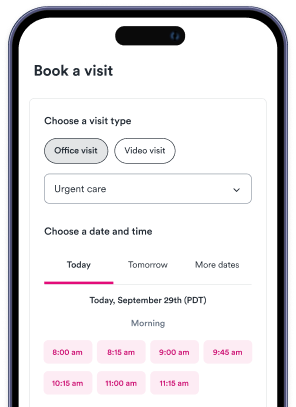
Yes — urgent care can diagnose and treat a vaginal yeast infection in a single visit. Providers can take a history, perform a focused exam, prescribe an oral or topical antifungal, and tell you whether your symptoms might be coming from a different infection that needs different treatment.1,2
What is a vaginal yeast infection?
A vaginal yeast infection — clinically called vulvovaginal candidiasis — is an overgrowth of yeast (most often Candida albicans) in the vagina. It is extremely common: about 75% of women will have at least one episode in their lifetime, and roughly half will have a second.1
Typical symptoms include:
• Itching, burning, or irritation of the vulva and vagina
• Thick, white, "cottage cheese"-like discharge (usually without strong odor)
• Redness and swelling around the vaginal opening
• Pain or burning with urination or sex1,3
Can urgent care treat a yeast infection?
Yes. Urgent care is a reasonable option when you cannot get a same-day appointment with your primary care provider or gynecologist. A clinician can:
• Ask about symptoms, sexual history, recent antibiotic use, and prior infections
• Examine the vulva and vagina and, when appropriate, collect a sample for microscopy or culture
• Confirm yeast infection versus bacterial vaginosis or a sexually transmitted infection, which look similar but need different treatment
• Prescribe antifungal therapy and provide follow-up instructions1,2
Many urgent care clinics can run a quick microscopy ("wet prep") in-house. Others send samples to a partner lab. Treatment is typically prescribed the same day based on clinical findings.
What treatment does urgent care prescribe?
The CDC's Sexually Transmitted Infections Treatment Guidelines and the AAFP recommend the following for uncomplicated vulvovaginal candidiasis:1,2
• Oral fluconazole: A single 150 mg dose by mouth. Some clinicians prescribe a second dose 72 hours later for slower-to-clear symptoms.1
• Topical azole creams or suppositories: Examples include miconazole, clotrimazole, terconazole, and tioconazole. Courses range from 1 to 7 days depending on the product.1
Both approaches have roughly an 80% cure rate for uncomplicated infections. Topical preparations may cause local burning during the first dose but otherwise have minimal side effects.1,3
What about recurrent or severe yeast infections?
If you have four or more yeast infections in a year, you have recurrent vulvovaginal candidiasis. The CDC recommends:
• An initial intensive treatment phase — typically 7 to 14 days of topical therapy or three doses of oral fluconazole (day 1, 4, and 7) — followed by
• A maintenance phase, usually weekly oral fluconazole for 6 months1,2
Severe cases (extensive vulvar redness, swelling, fissures) also need longer treatment courses. These patterns should be managed in partnership with a primary care provider or gynecologist rather than treated only at urgent care.1,2
What about yeast infections in pregnancy?
If you are pregnant, oral fluconazole is not recommended. The CDC notes that a single 150 mg dose has been associated with possible spontaneous abortion and congenital anomalies in epidemiologic studies. Only topical azole therapy (applied for 7 days) should be used during pregnancy.1
Always tell your urgent care provider if you are pregnant or could be pregnant before any prescription is written.
When is it not a yeast infection?
Vaginal symptoms have many causes, and self-diagnosis is often wrong. The AAFP notes that fewer than half of women with self-diagnosed yeast infections actually have one.3 Conditions that mimic yeast infection include:
• Bacterial vaginosis — thin, gray-white discharge with a fishy odor
• Trichomoniasis — frothy, yellow-green discharge with strong odor, often with irritation
• Atrophic vaginitis — thinning of the vaginal lining after menopause
• Allergic or irritant reactions — to soaps, douches, lubricants, or laundry detergents
Urgent care can examine and test for these conditions and adjust treatment accordingly.2,3
When should you go to the ER instead?
Yeast infections themselves rarely need emergency care, but go to an ER or call 911 for:
• High fever (over 101°F / 38.3°C) with severe pelvic pain
• Heavy vaginal bleeding that is not menstrual
• Severe lower abdominal pain that does not improve
• Confusion, fainting, or signs of severe systemic infection3
How can you lower your risk of recurrence?
The Cleveland Clinic and AAFP suggest these everyday practices to reduce yeast infection risk:
• Wear breathable cotton underwear and avoid tight, damp clothing
• Change out of wet swimsuits or workout clothes promptly
• Avoid douches, scented hygiene sprays, and harsh soaps
• Wipe from front to back after using the bathroom
• Manage blood sugar carefully if you have diabetes, since high glucose levels promote yeast overgrowth3
Next steps
If you have new or recurrent symptoms of a yeast infection, you do not need to wait days for a specialist visit. Find an urgent care or same-day clinic on Solv to get an exam, the right diagnosis, and prescription treatment the same day.
Frequently asked questions
Can urgent care prescribe Diflucan (fluconazole) for a yeast infection?
Yes — most urgent care providers can prescribe a single 150 mg oral dose of fluconazole (Diflucan) for an uncomplicated vaginal yeast infection, provided you are not pregnant. The medication is typically sent to your pharmacy electronically.1
How quickly do yeast infection symptoms improve after treatment?
Most people feel some relief within 24 to 48 hours of starting treatment. Itching and irritation usually resolve within 3 to 7 days. If symptoms have not improved after a week, follow up — a different infection or a resistant strain may be the cause.1,3
Should my partner be treated too?
For uncomplicated vaginal yeast infections, partner treatment is generally not necessary, because the condition is not sexually transmitted in the traditional sense. Male partners with symptoms of balanitis (itching or rash on the penis) can be treated with a topical antifungal.1
Can I just use an over-the-counter cream instead of going to urgent care?
For a first-time mild infection where the symptoms are classic, OTC azole creams (like miconazole) work for many people. Go to urgent care if it is your first time, if symptoms are severe, if you are pregnant, if you have diabetes, or if OTC treatment has not worked.2,3
What if I keep getting yeast infections?
Recurrent infections (four or more per year) usually need a longer treatment course followed by months of maintenance therapy. Underlying issues like uncontrolled diabetes, immunosuppression, or hormonal changes should be evaluated. Follow up with a primary care provider or gynecologist for a long-term plan.1,2
Does insurance cover urgent care visits for yeast infections?
Most commercial insurance plans, Medicare, and Medicaid cover urgent care visits and prescription antifungals. Generic fluconazole is inexpensive even without insurance — often under $20. Confirm in-network status if cost is a concern.
 Urgent care near me